


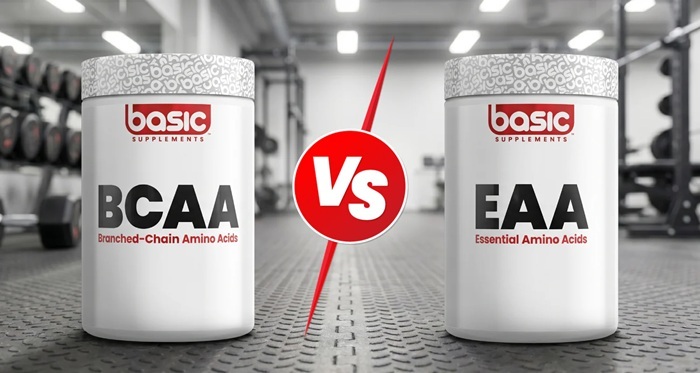
Key takeaways:
- Essential amino acids (EAAs) cover all nine aminos your body can’t produce on its own; BCAAs cover only three of them
- BCAAs trigger muscle protein synthesis but EAAs provide the full set of building blocks needed to complete it
- EAAs are the more complete option, particularly for people with inconsistent protein intake or those training fasted
- BCAAs remain useful intra-workout when total daily protein intake is already high
- Both absorb faster than whole protein sources, making them practical during or around training
Essential Amino Acids and BCAAs: Understanding the Difference
An essential amino acids supplement and a bcaa supplement both support muscle recovery and performance, but they work across different scopes. The distinction matters when you’re deciding which one to buy and when to use it.
Amino acids are the building blocks of all proteins in the body. There are 20 amino acids in total. Your body can synthesise 11 of them from other compounds. The remaining nine are essential, meaning they must come from food or supplementation because your body has no way to produce them independently.
What EAAs are
The nine essential amino acids are histidine, isoleucine, leucine, lysine, methionine, phenylalanine, threonine, tryptophan, and valine. All nine must be present for muscle protein synthesis to run to completion. If even one is in short supply, the process is limited regardless of how much of the others are available.
An EAA supplement delivers all nine in one serve, covering the full requirement for muscle building and repair without relying on food intake at that moment.
What BCAAs are
BCAAs are three of the nine essential amino acids: leucine, isoleucine, and valine. They’re called branched-chain amino acids because of their molecular structure, and they’re found in particularly high concentrations in skeletal muscle tissue.
Leucine is the primary driver of muscle protein synthesis. It acts as the trigger that initiates the process. Isoleucine supports glucose uptake into muscle cells during exercise. Valine plays a role in energy production and reducing central fatigue.
BCAAs are effective at what they do. The limitation is that they only cover three of the nine aminos required for full muscle protein synthesis. The other six still need to come from somewhere.
When EAAs Make More Sense
EAAs are the stronger choice in three situations. They suit people training fasted, those with inconsistent daily protein intake, and anyone wanting the most complete amino acid coverage in a single supplement.
Training fasted is the clearest use case. If you train before eating, your body’s available amino acid pool is low. BCAAs provide a partial top-up. EAAs provide everything your muscles need to initiate and sustain protein synthesis through the session without any dietary protein present.
For people whose total daily protein intake is inconsistent or below the 1.6 to 2.2g per kilogram of bodyweight target, EAAs cover more ground than BCAAs and are a more complete investment.
When BCAAs Make More Sense
BCAAs are a practical choice when your overall protein intake is already solid and you want a fast-absorbing intra-workout option that’s easy on the stomach during training.
If you’re hitting your daily protein target through whole food and protein powder, your muscles already have access to all nine essential amino acids. In that context, BCAAs provide the specific aminos most directly involved in muscle performance and recovery during the session itself, without the broader EAA profile you’re already covering through diet.
BCAAs also tend to be more cost-effective per serve than EAAs. If your nutrition is dialled in and you’re using them purely as an intra-workout support tool, BCAAs do the job without the premium.
How to Take Each One
Both EAAs and BCAAs are best used around training. The most effective window is during your session, sipped through your workout to maintain an anabolic environment and reduce muscle protein breakdown.
EAAs can also be taken pre-workout in a fasted state, or post-workout if you can’t access a full meal or protein shake quickly after training. BCAAs are most commonly used intra-workout, where their fast absorption and specific role in muscle performance are most relevant.
Typical effective doses sit at 10 to 15g for EAAs per serve and 5 to 10g for BCAAs, with a leucine content of at least 2 to 3g per serve for BCAAs to produce a meaningful muscle protein synthesis response.
Neither replaces a quality whole food diet or a complete protein supplement as your primary protein source. They work best as targeted additions around training, not as standalone nutrition.
FAQs
Can I take EAAs and BCAAs together?
There’s no harm in it, but it’s largely redundant. EAAs already include the three BCAAs. Taking both at the same time adds cost without meaningful additional benefit. Choose one based on your situation.
Do EAAs or BCAAs break a fast?
Both contain calories and amino acids that trigger an insulin response, so technically yes. Whether this matters depends on your reason for fasting. For training performance and muscle retention, taking EAAs during a fasted training session produces better outcomes than training without any amino acid support.
Are EAAs or BCAAs better for women?
Both are appropriate for women. The decision comes down to the same factors as anyone else: daily protein intake, training style, and whether the goal is fasted training support or intra-workout recovery. EAAs are the more complete option across the board.
How quickly do EAAs and BCAAs absorb?
Both absorb significantly faster than whole protein sources because they require minimal digestion. Effects are typically felt within 15 to 30 minutes of consumption, which is why intra-workout timing is practical.
Do I need EAAs or BCAAs if I already take protein powder?
Not necessarily. A complete protein powder like whey already contains all nine essential amino acids including BCAAs. Standalone EAA or BCAA supplements are most valuable when you want fast-absorbing amino acid support during training without consuming a full protein shake.